Review of "Derby" Pony Play Boots
The Derby - Ballet Style Hoof Boots
Reviewed by cPony on Dec 29 2011
Links last updated on Dec 29 2024
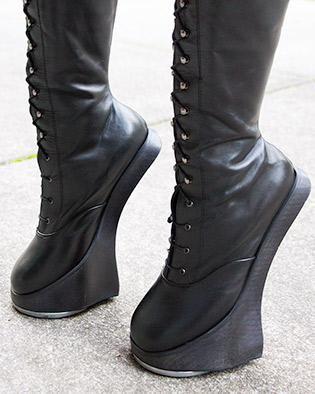
Derby hoof boots. Photo by cpony.com
The Derby hoof boot from Punitive Shoes is specifically marketed for ponyplay. The Derby (in addition to the other hoof boots sold by Punitive Shoes) is very nearly a ballet boot with a genuine horseshoe1 on the bottom for that realistic touch (this has changed since I purchased my pair and wrote the review - see footnote for details).
If you come to ponyplay as an extension of BDSM, or really enjoy the bondage aspects of ponyplay, you will probably appreciate the way this boot feels.
These boots are available in black, red, or white leather with either patent or matte finish. The pair I own are matte black. The Derby hoof boot is a knee length boot, but Punitive Shoes also makes both ankle (the Rancho) and thigh (the Palio) length pony hoof boots.
These other hoof boots only differ in the length of the boot, and all retain the same heel (or lack thereof in this case) style. The also sell a pony shoe (the Ascot), which is in the same style as the pony hoof boots but does not rise above the ankle.
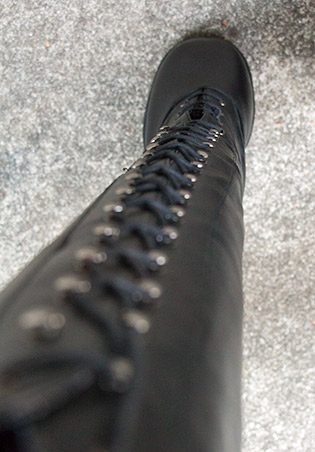
View down the Derby boot. Photo by cpony.com
If you need to pull a cart or really do any jogging or running, there boots are probably not going to be your first choice (though I have seen a ponyboy pull a cart through several circuits of Folsom street fair wearing the thigh high version of these boots, so it is possible with practice).
These boots are best suited to a photo shoot or play scenes not requiring much walking. Don't get me wrong, I absolutely love these boots (in part because they are so difficult to walk in, which adds another element of bondage), but you could easily fall if you're not experienced walking in ballet type shoes/boots (which I'm not).
I found the size seemed to run about 1/2 size small. Additionally, I have slim calves, so I had to have the uppers taken in to achieve a proper fit (though I have had to do this for bio-horse riding boots, so it is not specific to the Derby).
Thus, if your calves are slim relative to your shoe size (and form fitting uppers are important to you), you might consider setting aside a few dollars for leatherwork (FYI: it cost me $75 to have the uppers taken in). Also, my personal experience was the laces broke after ~10 outings. These are inexpensive to replace, but it was annoying to have to do so.
I replaced the stock laces with a sturdier pair of laces. After doing so, I had no further issues with the laces even after more than 100 outings and wearings, including some in some adverse conditions. The design of the boot uses the laces to keep the pony "on point", which causes the laces to bear a large strain. This is necessary due to the design of the boot, and perhaps any boot that forces its wearer into a similar position will necessitate a similar design.
One other "defect" that appeared after a few dozen wearings is the eyelets for some of the lacings (the ones that are taking the most strain and being used to keep the wearer "on point"). This was a more involved repair, and it could easily have become an even larger problem if the eyelet hole (from which the eyelet popped out), being exposed to the thin bootlace, ripped or tore, preventing the replacement of the eyeley.
I am not sure if this issue could have been prevented with a thicker eyelet to better distribute the force the laces pass on to the eyelets, or perhaps a thicker gauge leather could be used to construct the upper. I think the former would be the best solution - inexpensive and minimal modification to the design of the boot would be required. Regardless, be aware of this issue when purchasing the boots, and carefully inspect the eyelets lower down the boot everytime prior to and after wearing them.
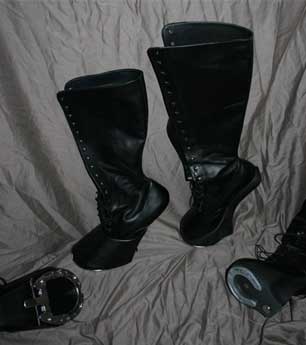
Derby (right) hoof boots compared to Reactor (left) boots. Photo by cpony.
The photo at the right compares the overall design (including the attached horsehoe) of the Reactor hoof boot (left two boots in the photo) and Punitive Derby hoof boot (right two boots in the photo).
As you can see, the Punitive hoof boot uses a smaller horseshoe and does not have the metal bar extending backwards (this bar seems to help in balancing). If you are proficient at welding and want to make the boot slightly easier to balance in, you might wish to emulate the design of the attached horseshoe used in the Reactor hoof boots where an attached metal bar extends behind the attached horseshoe and aids in balancing (it isn't terribly difficult to weld the 1" wide x 3/8" thick steel used for balancing bar with a home welder).
What may not be so obvious from that photo is that in addition to providing a smaller surface area for balancing (see close up below - right pane is the Derby, the left pane in the photo below is the Reactor for comparison), the smaller horseshoe provides less traction.
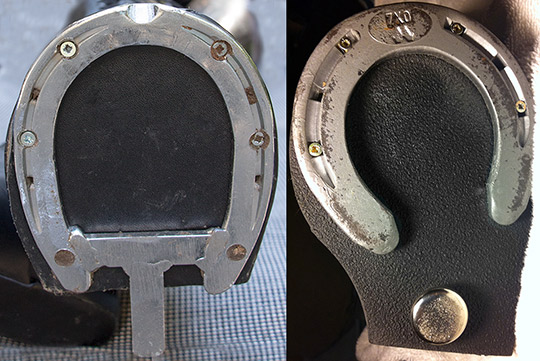
Comparison of the bottom of the Derby (right) and Reactor (left) hoof boots. Photo by cpony.
Thus it is easier to slip on hard surfaces such as concrete, wood, etc. However, the attached horseshoe is easily removed (along with that little metal button) to allow for better traction. Clearly, removing the horseshoe detracts from the overall appearance of the boots, but there are situations when this may be appropriate.
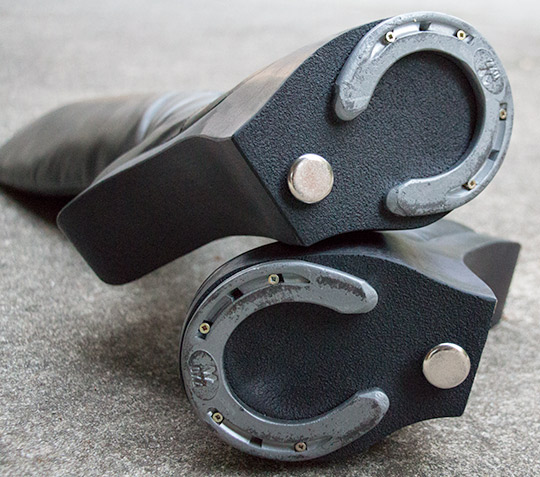
Bottom of the Derby hoof boots. Photo by cpony.
Rating
My overall rating is 4.5 out of 5 sugar cubes
 for the Derby pony boots. They gain half a point because of their incredible pricepoint (when compared to other hoof boots). The boots are well made: they have lasted me many uses and are still going strong (aside from the laces, which, due to the design of the boot, must take a lot of stress). They are most definitely a bondage boot, but I consider this a benefit. Moreover, they sound realistic and look quite nice.
If you are interested, you can buy them directly from Punitive Shoes for €259.00 EUR €329.00 EUR2. The price is quite reasonable, especially when compared to other hoof boots.
One final issue I'd like to address is shipping. The company reports the boots will ship in 45 business days, and when I ordered my pair, they shipped on the 43rd busness day after I placed the order. I actually received them about 10 days after that (I'm in the U.S. and they are based in Italy). So, my experience is they do ship within the quoted time. You should plan on waiting about 10 weeks depending on where you live, but I found they are well worth the wait.
Footnotes
You should keep this in mind when ordering since the photos on their website have not been updated to reflect this change. Thus, the horseshoe you will receive is not what is pictured. However, I am told that aside from the horse iron, the boots they are currently shipping are the same as what I have reviewed above.