Spurs
Pony Play Tack: Spurs for Trainers of Riding Ponies
Written by cPony on
Last updated on
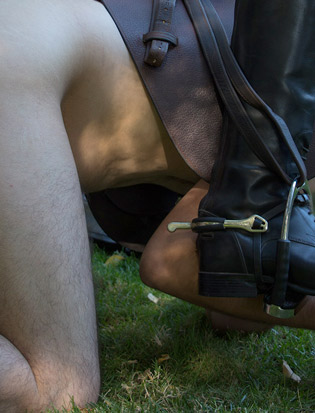
T riding me in a bio-equine jumping saddle. She has non-rolling spurs on her field boots. Photo by cpony.com
In bio-horse riding (in English riding disciplines at least), spurs are used to lend precision to the riding aids, which is important in all equestrian disciplines. The spur lets the horse distinguish between two commands (think of typing with fingers (spurs) versus trying to type with your whole hand with an open palm (leg without spurs)).
In ponyplay, this is usually not the case (though with some show/ridden ponies it can be); a rider uses spurs on a ponyboy or ponygirl to encourage the pony to go faster, or to punish or correct any misbehavior on the pony's part.
Using Spurs in Pony Play
An important question to ask is: why do want spurs in ponyplay? There are two main reasons: the first being similar to their use in bio-horse riding: to enhance the precision of the riding aids and occasionally get the attention of a pony whose mind wanders, in which case you probably want a milder spur. The second reason, more unique to pony play, is if your pony enjoys (or at least does not mind and consents to) a little pain, in which case you may want a harsher spur.In the latter case, the rider be very liberal and non-specific while using the spur. This should be discussed beforehand so that the pony knows to expect a degree of pain inflicted upon them with the spur, and also knows that use of the spur does not necessarily mean the rider is signaling anything specific that they want the pony to do - this avoids confusing the pony.
Let's start with a brief overview of what a spur is and what its basic parts are: A spur consists of a shank, neck and rowel. Many English spurs are thin, short, blunt and do not rotate, whereas western spurs tend to be heavier, longer and contain rowels that rotate.
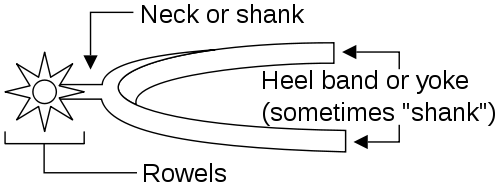
Photo by Wikpedia user Graevemoore (license: CC BY-SA 3.0).
Regardless of what you want the spur for, I would recommend starting off very slowly since spurs can cause serious injury. If you have never used spurs before, it can be very easy to misjudge the harshness of a spur and how much pressure is too much.
Points to remember when choosing spurs:
- A spur with a pointed/sharp end will be harsher than a spur with a dull/blunt end.
- A spur with a blunt flat end will be harsher than a spur with a blunt rounded end.
- Non-roller spurs will generally be harsher than roller spurs (if the end is the same shape and diameter).
- If you pick two spurs with rotating rowels, the one with fewer teeth (assuming the tooth diameter is the same) will be harsher.