Basics of Fitting a Bit
How to Fit Your Ponyboy or Ponygirl with a Bit
Written by cPony on
Last updated on
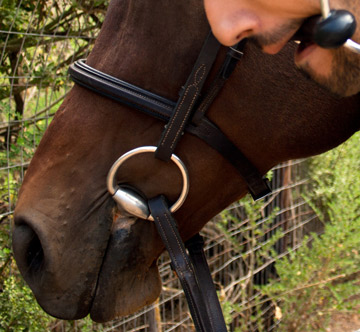
A proper fitting bit is just as important to a human pony as to a bio-horse. The two wrinkles on the side of the mouth (seen on both the human and the horse) indicate a properly fitted bit.
When fitting a bit, there are three main considerations: how wide is your pony's mouth (i.e. what is the opimal bit size, and how small a bit can he accomodate), how to attach it, and how tight to attach it.
The first step is to measure your pony's mouth. This will give you a starting point for what approximate size mouthpiece you should use on your pony. Of course, the style of the bit will also have a bearing on whether you should go up one or two sizes. For example, some bits can pinch the sides of your pony's mouth, and thus you should buy a bit 1/4" - 1/2 wider than the width you measure.
Fortunately, it's quite easy to measure your pony's mouth. There are two convenient tools that let you size your pony for a bit: a Bit Measure and a Bit Sizer. Here it is being used to size my mouth (which turns out to be 3 1/2" (as you can see in the photo below) for a non-pinching snaffle, or up to 4" for bits that can pinch):
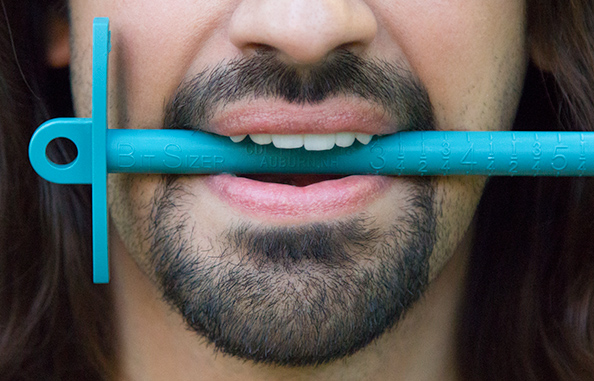
Use the bit sizer by placing the long ends at one side and push until nearly flush with his cheeks. Read the closest number off the other end that extends out of his mouth. This is his bit size. You may wish to go to a high size depending on the type of bit you wish to use one him (e.g. some bits should be allowed an additional 1/4 - 1/2" to prevent cheek pinching).
The type of bit a pony wears will dictate how it is attached to his bridle and where the reins attach:
- Snaffle - the reins are attached to the same bit ring that attaches the bit to bridle.
- Curb - the reins are attached to a different ring than is used to attach the bit to the bridle, usually the rings are separated by several to many inches and the mouthpiece is close to the bridle attachment. A curb strap (goes under the chin) is typically necessary for this bit to work optimally.
- Pelham - gives the option to attach reins in either snaffle, curb, or both configurations.
- Gag - the reins and the cheekpieces of the bridle are directly connected to each other. The cheekpieces/reins and threaded through holes in the bit rings (rather than attaching to the bit). This means when the reins are pulled, the bit will run along the cheekpieces, drawing the mouthpiece upwards to an unlimited degree (in contrast to most other bits, where the bit attaches to the end of the cheekpiece). I'm working on a tutorial on converting a bio-horse gag bridle for human use (similar to this one on converting a standard bio-horse bridle to fit a human pony).
If you aren't precisely sure what bit you have, a snaffle is usually a good bet. Most ponies (and many bio-horses) wear some kind of snaffle. Gag bits (distinct from a "bit gag", which is a sort of generic term for any horse bit converted for use in BDSM) are probably the least common on human ponies since they require a unique bridle and rein setup.
The second consideration is how tightly to attach it. A properly fastened bit should sit behind the front teeth. In fact, it should be pulled back into the mouth far enough and snug enough to create two wrinkles in the skin at the corners of the mouth (as a general rule, but your pony's comfort should come first - there's no wrong way).
When choosing a bit keep in mind that whatever bit you choose should be comfortable for the pony to wear at that degree of snugness. This is generally only a problem for bits with more complicated mouthpieces (e.g. ports, thin wires, spiked, etc.), but it is something to keep in mind if you do decide on something other than a simple straight or broken mouthpiece.
Generally a little too tight is better than a little too loose (not a hard and fast rule by any means, but subtle reins signals can be lost if a bit is too loose), assuming your pony is okay with that.