ErosTek ET232 Review
Portable Electrical Pony Play
Written by cPony on
Last updated on
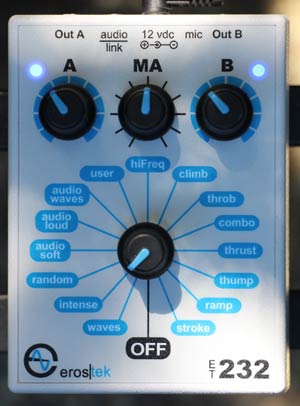
Top of the ET232.
I have always wanted a dedicated e-stim unit so I decided to splurge and buy one. I chose the ET232 over the ET312B because the former is much smaller and lighter (3.3" x 4.4" x 1.5" and 0.35 pounds for the ET232, versus 8.0" x 6.5" x 2.5" and 4 pounds for the ET312B) - making it feasible to attach the ET232 to a ponyboy's harness (for example).
Though I was tempted by the additional features of the ET312B, the $500 price tag combined with the large dimensions swayed me in favor of the ET232: the ET-232 is about one half to one third smaller than the ET-312B in every dimension, and at less than 1/10 the weight of the ET312B, the ET-232 is significantly lighter making it feasible to attach to a harness.
While the ET232 can indeed be easily attached to a harness, it isn't a remotely controlled unit (though it could easily be made into one if you're not shy about a little modification) so you will have to either preset the program you want your pony to experience (perhaps to test a pony's ability to concentrate under distracting stimuli), or be near enough to the box to change the stimulation program and/or level. Alternatively, you can use the built in microphone to punish (or reward - depending on the placement of the electrodes and stimulation level) a loud pony.
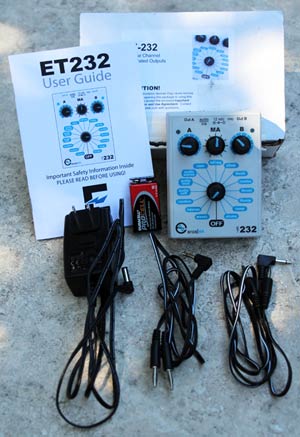
ET232 and included accessories.
What's in the Box
In addition to the power box itself, there are two (one for each output channel) 3.5mm (male) plug to 4mm banana plugs. Also included is an AC adapter, a 9V battery, and the user manual.You will need to purchase a bipolar electrode (or a pair of unipolar electrodes) to get started. However, some retailers will include a complimentary pair of basic electrodes so you can start to have fun right away. Mr. S included a pair of blue elastic electrodes with the ET232. I also ended up buying another electrode: a bipolar ring that fits around the cock and balls.
One thing worth mentioning is to make sure any additional electrodes you buy accept 4 mm banana plugs as input. If they do not, you will need to buy an adapter (or two adapters - as I had to for my bipolar ring). This wasn't an issue because I was in the store and could see (or ask an associate) what I needed, but if I were ordering online, I can imagine missing this and being disappointed that I can't use my new toy when I received my package (though you could probably get any adapters you need from Radio Shack, Fry's, etc.).
It's also probably not a bad idea to get a bottle/tube of electrode gel. It's pretty cheap (less than $10 for a huge tube), and it really does help make good, consistent electrical contact (which can reduce the likelihood of burns, and also deliver a more uniform sensation).
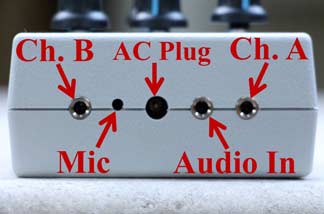
Front panel of ET232.
User Interface
The top of the ET 232 (see figure at top right) has 4 dials: two knobs labeled "A" and "B" which adjust the intensity/amplitude of channels A and B. Another knob is labeled "MA" (for MultiAdjust - I'll talk more about this knob below), and there is a central knob, which sets the stimulation mode.The front panel (see figure at right) of the ET-232 has the outputs for each channel (A and B), which accept 3.5 mm male plugs, in addition to a central plug for the AC power adapter (which needs 12 VDC) and an audio line input as well as an opening for the built in microphone.
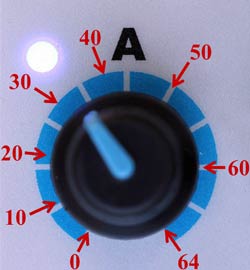
Although it turns smoothly, the output intensity only has about 64 distinct settings - they are not spaced evenly on the knob unfortunately, making adjustment especially difficult at the higher power levels.
Intensity Knob
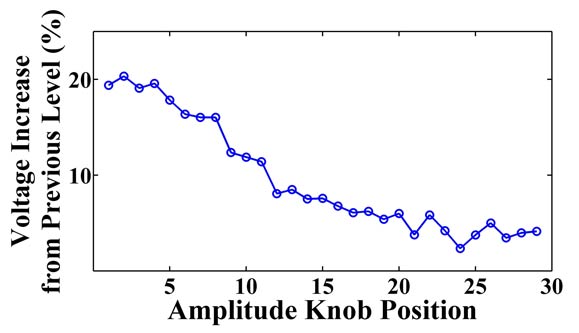
The intensity/amplitude knob changes the maximum (peak to peak) output voltage. I say "maximum" because most stimulation programs vary the output voltage (among other things) so that the sensation varies with time. The primary exception being the "intense" mode (and to a lesser degree the "thrust" mode), which deliver groups of pulses at a constant intensity.While the amplitude dials turn very smoothly, I found the subjective sensation to "jump" almost as though it had defined stimulation levels (that were spaced a little too far apart) as opposed to a continuum. I checked this on the scope (using the "intense" mode because in this mode, the pulses are of constant amplitude) and the amplitude does indeed jump by 2.2V ± 0.4V peak to peak (output voltage as a function of the intensity dial - there are no intermediate points in that figure - the output jumps between the measured values (see figure at right for how I labeled intensity levels on the dial)).

I was a little disappointed that the voltage - and thus the subjective intensity - could not be adjusted more gradually (to give you a rough idea, one level can correspond to as much as a 20% change in amplitude at the lower levels). Though this is not the end of the world (and indeed every shock collar I have tested also has distinct intensity levels), I would prefer to have finer control over the intensity of the output.
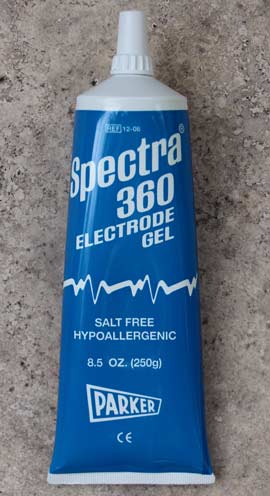
A tube of electrode gel. At $7.50, it's pretty inexpensive, and it really helps electrical contact.
I tested the peak to peak voltage of individual pulses when varying the amplitude from the first white mark ("zero" setting in figure) to the maximum ("64" in the figure). It appears there are only 64 total gradations in intensity. Moreover, the settings are not spaced evenly on the dial (though the change in voltage between levels is constant). Its maximum intensity is around 150V.
Aside: ErosTek utilized the Atmel ATMEGA8 microcontroller, which has a 10 bit (10 bit = 1024 possible values) analog to digital converter (ADC), so it's not immediately clear to me why there are only 64 settings. Possibly the Vref of the ADC is quite a bit higher than the maximum possible input from their intensity knob, or they're running the ADC at a really high frequency - but these are just guesses on my part. I will examine this in more detail and let everyone know what I find out. Also, I am told that the ET312B, similar to the ET232, only has 64 distinct levels (though it shows a numerical value up to 100 on the LCD, it apparently skips numbers for a total of 64 actual levels).
Although the ET232 is technically rated (according to ErosTek's spec sheet) for a maximum of 80V peak to peak, I measured maximum output as 151.8V (with the electrodes attached to my body, so it's into a reasonable load). I'm inclined to believe my own measurements though I am a little suspicious that my peak-to-peak meaurement is about half of ErosTek's rated 80V maximum - perhaps my body has more resistance than normal, or ErosTek's measurements were defined differently than I expected, but I'm confident in my measurements.
MultiAdjust Knob
The MultiAdjust ("MA") knob changes the subjective feeling of a stimulation program. Typically turning the knob clockwise increases the rate at which the program seems to repeat. The user manual does a good job of explaining what the MA knob does for each individual stimulation program, but I'll give you an example below from my own subjective experience (as well as measurements made with the oscilloscope).As an example, in "intense" mode, turning the MA dial from the leftmost setting through to about the center gradually decreases the time between individual pulses, decreases the number of the pulses per pulse train, and increases the frequency of subsequent trains of pulses. However, after about the halfway point on the MA dial (the ET232 specifications state an approximately 300Hz maximum frequency, which explains this transition), continuing to turn the knob clockwise makes the pulses continuous (i.e. no longer separated into pulse trains, or not modulated by a square wave any longer) and then starts to increase the time between subsequent pulses.
My suggestion is to start out in the "intense" mode (around half way on the MA dial) to decide on an intensity level for other programs. I like this method because the "intense" mode is just a series of pulses at constant intensity (for a given setting of the intensity dial).
Stimulation Programs
The ET 232 has 15 stimulation modes available on the selection dial (including the three audio sensitive modes and the "user" mode):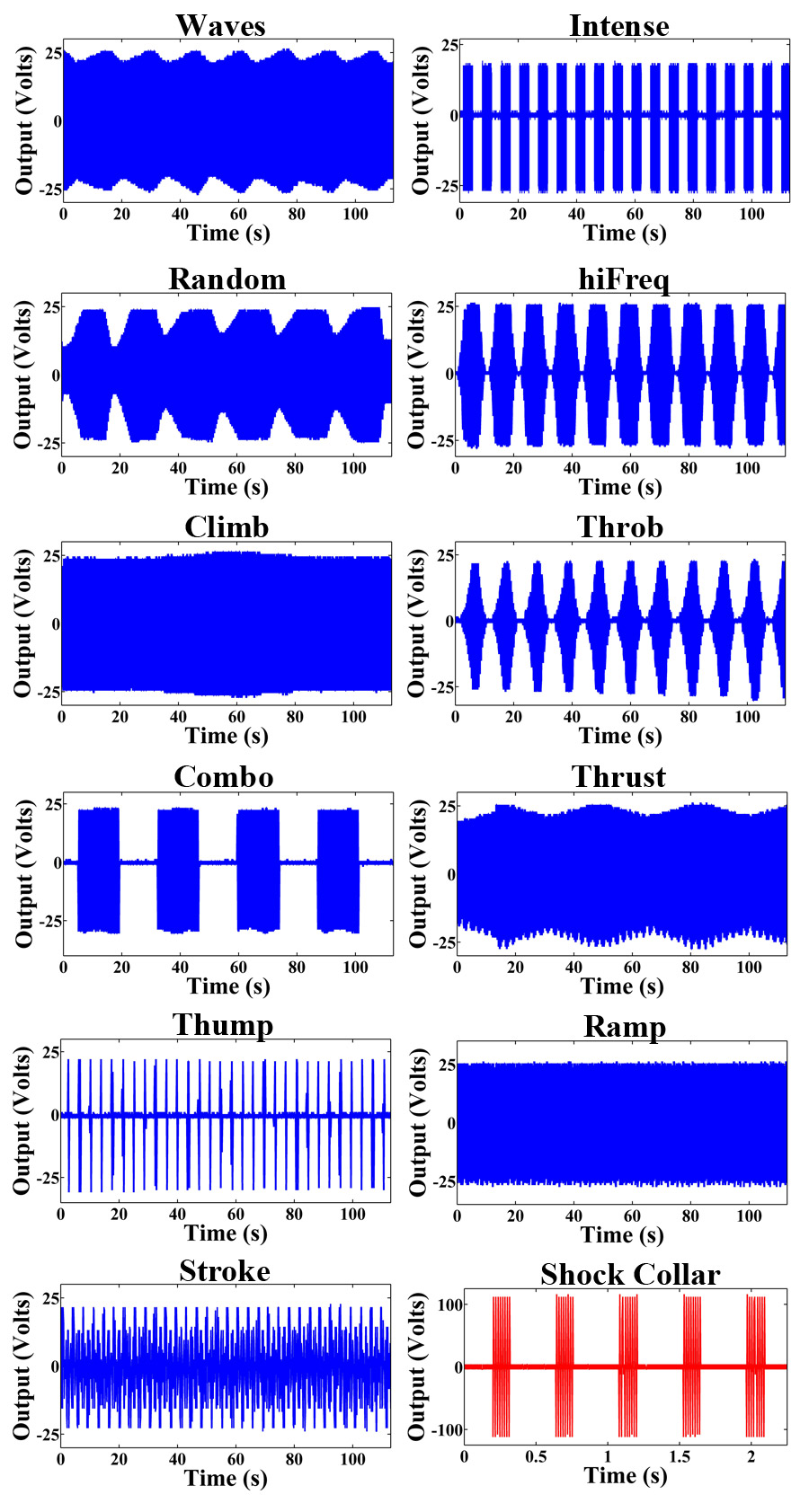
Waveforms of the 11 preset stimulation modes and that of a standard shock collar (red, bottom right) for comparison. You can click the image (or here) for a higher resolution version
- Waves - As the name implies this setting produces a wave sensation with the intensity waxing and waning smoothly and gradually. This is a great mode to use to tease your pony for a long period of time. The sensation is achieved through varying the distance between individual pulses and modulating the pulses with a sine wave.
- Intense - This setting is essentially groups of pulses (constant pulsing modulated by a square wave) and can produce a very similar sensation as a shock collar by fiddling with the MA knob (subjectively, around "6" on MA dial produces a very similar sensation to a shock collar - the scope verifies this, but the rate of pulse group repetition is higher than with the shock collar I compared against). Within each group, the pulses are at a constant frequency and intensity (varying the MA knob up to about the fifth setting on the dial changes rate at which groups of pulses are repeated (i.e. frequency of modulating square wave) as well as the distance between pulses within the groups).
- Random - It feels similar to waves, but the frequency of the modulating (sine) wave varies over time. I have not tried this mode for a very long period of time, but if varied fairly gradually (see figure at right) for the time period tested.
- hiFreq - This mode produces a milder, though similar, sensation to that of a shock collar (or the intense mode of the ET-232). It feels a bit like pins and needles.
- Climb - The sensation builds from a thrumming to a more intense prickly feeling. The distance between individual pulses is varied.
- Throb - It actually feels like an even milder version of the hiFreq mode. This mode seems to be entirely amplitude modulated (i.e. only the amplitude of the pulses is varied at a given "MA" setting).
- Combo - The combo mode combines changes in interpulse distance with changes in pulse train length (similar to changing the frequency of a modulating rectanglar wave).
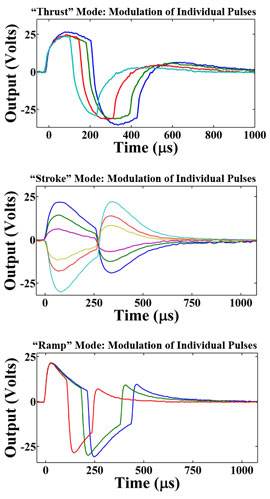
Some stimulation programs modulate the individual pulses themselves: making them longer or shorter, or even inverting them.
- Thrust - This mode is not only varies the intensity of the pulses, but it also changes the frequency and shape of the pulses themselves (the pulses vary progressively from the normal pulse shape (blue) to green to red to aquamarine, and then reverse back through red, green, and back to blue).
- Thump - Short groups of pulses that produce a sharp, low frequency sensation.
- Ramp - The distance between individual pulses is varied (the bottom pane of the figure to the right shows three pulses that occur during this mode's variation of pulse width).
- Stroke - Actually an interesting mode. It can indeed produce a sensation similar to stroking. It appears to achieve this by gradually inverting the pulse shape (the middle plot in three pane figure to the right; the pulse is varied as follows: from blue to green to purple to yellow to red to aquamarine and back) in progressive groups of pulses. This mode seems to be the only mode that does this.
- Audio soft - The pulsing is modulated by either the built in microphone or via the audio line in. This setting is more sensitive to audio input than the "audio loud" setting.
- Audio loud - The pulses are modulated by audio input: either via the built in microphone or the audio line in. This setting is not very sensitive to audio input - good for loud noises (e.g. screaming, hard spanking with a crop, etc.) or if you turn up the output from your iPhone, but not ideal for preventing talking.
- Audio waves - This mode is essentially the same as audio loud, but it also applies the waves program to the second channel.
- User - The user mode seems to provide an output very similar to that of the hiFreq mode. I'm not sure if that's because the user mode just continues the last mode the ET-232 was set for, or if this is a distinct mode, but either way, there is a definite output in user mode, and it's been nearly identical to hiFreq the couple times I checked it. I have read older reviews (pre-2013) that suggest User mode is a unique mode, so perhaps I have a newer firmware which changed that. Regardless, I cannot replicate any uniqueness to the "User" mode.
For Reward or Punishment
While pretty much any mode can be pleasurable or painful simply by varying the amplitude (and/or the position of the electrodes), Using a pair of unipolar electrodes (one at the base and one at just below the head of my penis) and running in "intense" mode, the sensation can go from pleasurable to way too intense by simply turning the MA knob.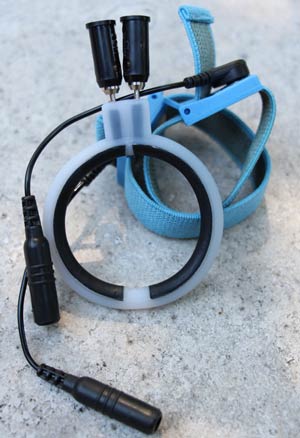
Unipolar blue elastic electrodes and round bipolar electrode (goes around cock and balls). The latter requires banana to pin adapters (seen at the top of the ring). No electrodes come with the ET232 though some retailers will throw in an inexpensive pair.
Electrodes
As mentioned above, the ET 232 does not come with any electrodes. While some retailers will include a basic pair of electrodes with your purchase, this is not guaranteed. Thus, you should plan on spending an additional $25 - $50 for electrodes. If you're male, my recommendation is to start with a simple pair of unipolar electrodes (like the blue elastic ones pictured in the figure at the right) that you can attach your cock and/or balls.I purchased a bipolar electrode (ring pictured in figure to the right) as well, but I was not overly impressed with the sensations produced by it (for pleasure - it works well enough for painful sensations, but requires the intensity setting to be turned up, then it feels like you were kicked in the balls).
Rating
I give the ET232 4 out of 5 sugar cubes . Originally, I was going to give it 3.5 stars, but the small form factor, and the less than 1/2 pound weight (including the battery) convinced me to bump it up another quarter star.
To earn a perfect 5/5, the ET232 would have to offer finer control of intensity settings (worth half to three quarters of a star) and more options for advanced users (worth about one quarter of a star), mainly more control over pulse width and the ability to add user defined modulation functions stored in memory on the device. Currently, the ET232 does not allow an easy interface with a PC (read: you have to open the box, remove the circuit board and manually interface with the chip - and even then you can't really do much except perhaps void your warranty), which is one of the main limitations.
Summary
Pros:- Very light and easily attached to a harness
- Easy to use
- Ample power for most uses
Cons:
- Insufficient granularity of power adjustment - the steps between subsequent intensity settings are too abrupt and do not offer enough fine control of the intensity of sensations. By far this is the biggest con of the unit in my opinion.
- Lacks convenient software interface and advanced settings
- Both of these cons could be remedied by upgrading their microcontroller (for very minimal added hardware costs), which is a bit dated in my opinion
I purchased my unit at the Mr. S Leather retail store in San Francisco for $299 USD in May of 2013 (Mr. S Leather no longer carries ErosTek products as of November 2024), but you can find ErosTek's products at various online and in store locations. In fact, you can even buy directly from ErosTek (the ET-232 sells for $349 USD directly from ErosTek as of December 2024).
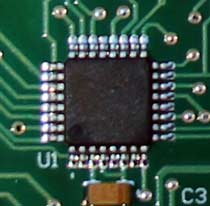
The microcontroller used by the ET232. While it is possible to interface with this particular chip, it is not trivial, and I'm quite sure you will void your warranty. Nevertheless, when I have more time, I will try to interface with it and see how much (if any) modifications I can make.
ErosTek offers a 1 year warranty on the ET232 when purchased new from an authorized retailer in the U.S. I can't comment on the warranty (since my unit is only a week old, the tone of this review would be very different if I'd had to make use of the warranty), but my understanding is I could either deal directly with ErosTek or I could take it back to the store I purchased it from and they would take care of everything.
One final thing I wanted to mention: the Erostek product page for the ET232 reads a little bit like a sales pitch for the ET312B, which is fine if you're confident in your purchase (e.g. having bought it for its reduced size and weight, against which the ET312B cannot compete), but if you purchased the ET232 due to price concerns alone, I think the product page may make you second guess your choice.
The ET232 is a full featured, lightweight e-stim unit that would be welcome in anyone's toybox. I'm not even sure that's its main shortcoming (lack of granularity in power adjustment) is addressed in its higher priced sibling (ET312B).
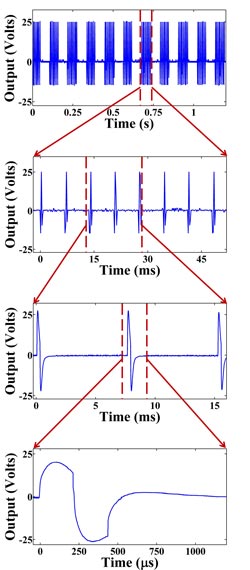
Simplified pulse structure schematic. Aside from the amplitude of pulses, the distance between individual pulses and the distance between groups of pulses can be varied to alter the subjective feeling.
Additional Notes
I wanted to briefly discuss a couple of the factors that go into the subjective sensation of e-stim. From top to bottom, the figure at the right illustrates the voltage output at smaller and smaller time scales. Obviously the amplitude (voltage) has a huge effect on the perceived sensation, but other factors can have a nearly equally large effect.Aside from voltage, one of the main factors in subjective sensation can be the modulating waveform. That is, the envelope of the pulses (in the figure at the right that is a square wave, as can be seen in the uppermost pane), which is most obvious at the longer time scales (see the figure above which illustrates the waveforms of each stimulation mode over ~100 seconds for examples of different modulating waveforms).
Another factor which has a large effect on the subjective sensation is the time between subsequent pulses (this is different from the time between groups of pulses, which would be a property of the modulating wave). The time between subsequent pulses can be seen in the two middle panes of the figure to the right. Several modes of the ET-232 vary this distance either as an inherent function of the stimulation mode, or when you turn the MA dial.
Finally, the shape of the individual pulses can be varied to alter the subjective sensation. The most obvious way to do this is changing the polarity (or the phase) as is done in the stroke mode (see figure above for how stroke mode changes individual pulses). Alternatively, the length (frequency) and even the shape of the pulse can be changed. For example, "ramp" mode changes the length of the pulses while "thrust" mode changes both the frequency and the shape (see figure above).
I compared the ET-232 to a standard shock collar (since the latter is what I have been mostly using for e-stim), which uses a rectangular wave to modulate its pulses (see red plot in figure above). If you look at the individual pulses themselves, the ET-232 has a very similar pulse shape and frequency as the shock collar:
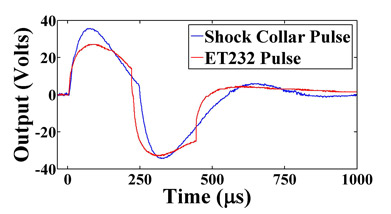
Comparison of the pulses generated by the ET232 (red) versus a shock collar (blue). Both devices were set to approximately 10% amplitude. The output voltage was measured going into a typical load (i.e. me).
The shock collar I used as a point of comparison uses an 8 pulse series (with a gap of 16 ms between individual pulses) repeated at approximately 2.25Hz. Only the output voltage of the collar changes. For reference, you can generate a similar sensation to a shock collar on the ET232 by setting the mode to "intense" and adjusting the "MA" dial to around the fifth line, which results in 8 pulses repeated at around 10Hz (you can either get the same number of cycles, or the same pulse repetition frequency (PRF), but not both. The reason for this is likely that the ET232 uses a square wave to modulate its pulses whereas the collar ues a rectangular wave).
The manual states that you should use electrodes with a contact surface area of at least 0.5 square inches. If you are used to using a shock collar, this number will seem quite large, but I can assure you that you can still achieve fairly intense sensations even with such a large contact area. In fact using smaller contact areas than recommended can (at least I observed this in my tests) distort the shape of individual pulses:
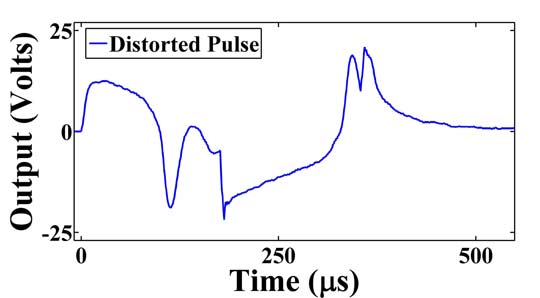
Distortion of individual pulses when output is coupled to high impedance (e.g. very small electrical contacts, much smaller than the minimum 0.5 square inches suggested by the manual).